Database Center
The Database Center gives you an overview of all your data. Saved data can be called from the scenario editor across all scenarios. Through the Database Center, you can also download databases or upload databases to the web app from other sources.
Overview of the databases
In the Sympheny Database Center (the database icon at the bottom left of your screen), you have access to up to two databases:
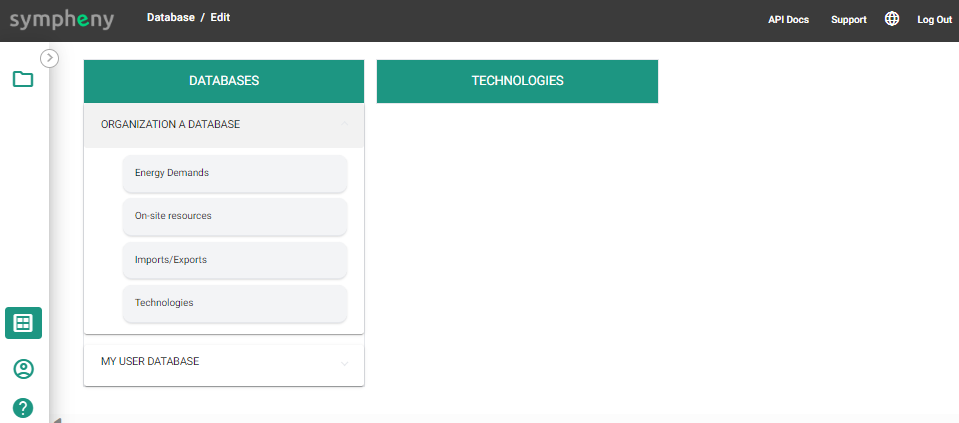
- My User Database: your own private database, available to you across all your scenarios. You can maintain this database directly.
- Organization Database: the database specific to your organisation, named after your organisation. Only accounts from your organisation can access this data. See the roles and permissions table below.
Roles & permissions
The account type and licence determine which rights are available to which users.
| Access | Organization Database | My User Database |
|---|---|---|
| Download | Organisation users | Individual user |
| Upload / Delete | Organisation admin users | Individual user |
Download databases
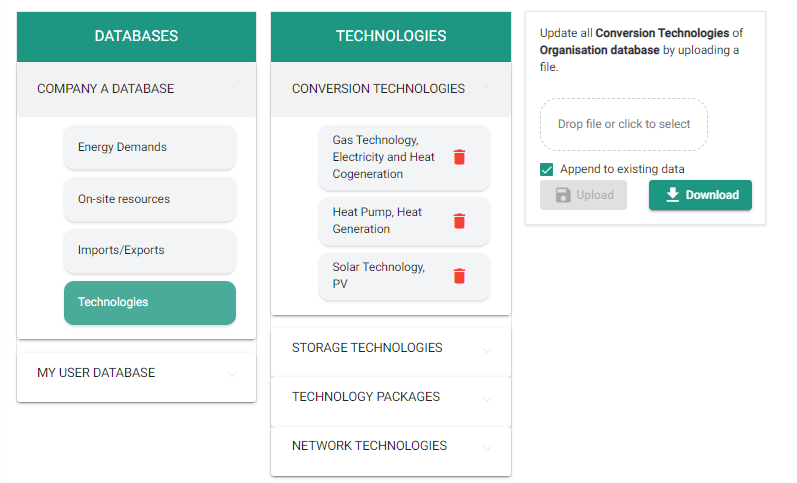
Downloading your database is useful when you want an overview of all your data, or need to perform post-processing or make adjustments.
To download your data:
- Navigate to the database and the type of data you want to download (for example, Energy Demands, On-site Resources, or a category of Technologies).
- On the right side of your screen, click the Download button.
- Scroll to the bottom of the page and click the download arrow.
- Open the downloaded file in Excel.
Tip
The format of the downloaded Excel file matches the format required for uploading databases.

Direct upload from Scenario Editor
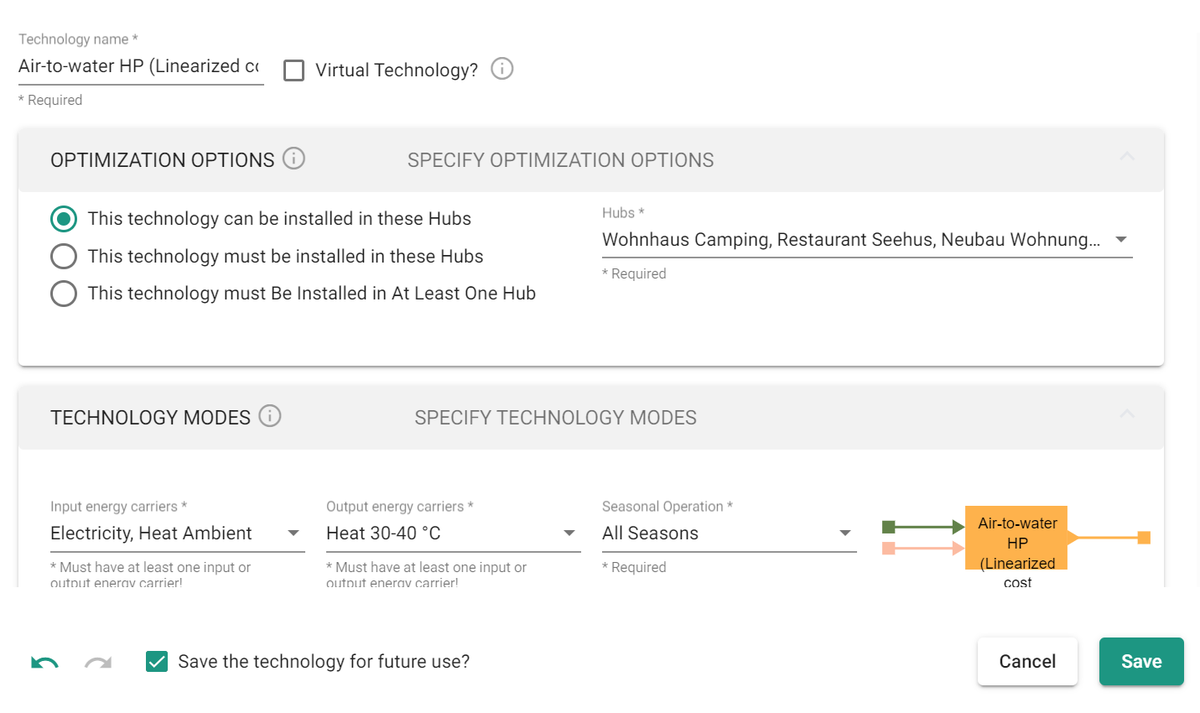
Conversion and storage technologies (scenario editor)
While editing a scenario, you can upload single items to My User Database directly from the scenario editor (in Setup) by selecting Save the technology for future use?
Energy demand profiles
This process is streamlined:
- In the Excel template, enter profile names in Sheet 1.
- In Sheet 2, add the corresponding profile under the columns with the same column names as in Sheet 1.
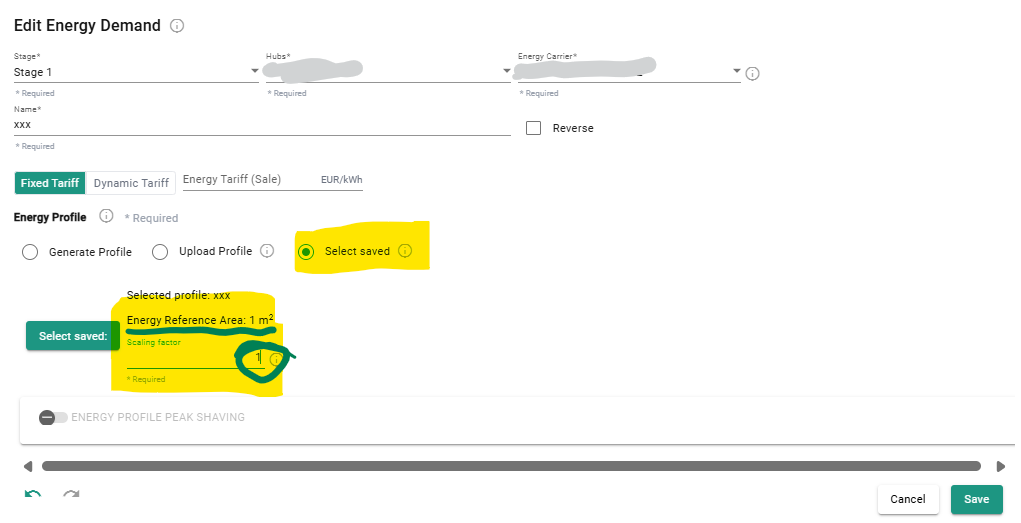
Select a saved profile
To use the data, click Select Saved when adding a new demand in step 4.
Upload from Database Center
To upload data to your databases, first prepare your data in the correct format. The parameters available depend on the type of data you want to upload. The databases you're allowed to modify depend on your roles and permissions within your organisation.
Conversion and storage technologies
- Select the database (My User Database or Organization Database) you want to add or replace data for.
- Select the type of data (Energy Demands, On-site Resources, or a category of Technology).
- Drop or select your file, then click upload.
By default, uploaded data is added to the existing database. To add new data without replacing the current content, keep Append existing data checked. To replace the entire database with the new data, uncheck Append existing data. This overwrites the existing database entirely.
Energy carriers naming conventions
Energy carriers (EC) must follow the exact nomenclature given in the table below.
After adding a specific technology from the scenario editor, you can change the energy carriers to any other EC available in that scenario.
| Energy carrier name | Nomenclature for templates |
|---|---|
| Cooling -20 - -10°C | COOLING_1 |
| Cooling -10 - 0°C | COOLING_2 |
| Cooling 0 - 10°C | COOLING_3 |
| Cooling 10 - 20°C | COOLING_4 |
| Ice | ICE |
| Electricity | ELECTRICITY |
| Electricity Renewable | ELECTRICITY_RENEWABLE |
| Biogas | BIOGAS |
| Gas | GAS |
| Hydrogen | HYDROGEN |
| Hydrogen Pressurized | HYDROGEN_PRESSURIZED |
| Oil | OIL |
| Coal | COAL |
| Wood Chips | WOOD_CHIPS |
| Wood Pellets | WOOD_PELLETS |
| Heat 0-10 °C | HEAT_1 |
| Heat 10-20 °C | HEAT_2 |
| Heat 20-30 °C | HEAT_3 |
| Heat 30-40 °C | HEAT_4 |
| Heat 40-50 °C | HEAT_5 |
| Heat 50-60 °C | HEAT_6 |
| Heat 60-70 °C | HEAT_7 |
| Heat 70-80 °C | HEAT_8 |
| Heat 80-90 °C | HEAT_9 |
| Heat Ambient | HEAT_AMBIENT |
| Steam Low Pressure | STEAM_LOW_PRESSURE |
| Biomass | BIOMASS |
| Geothermal | GEOTHERMAL |
| Hydro | HYDRO |
| Process Waste Heat | PROCESS_WASTE_HEAT |
| Solar Facade | SOLAR_FACADE |
| Solar Parapet | SOLAR_PARAPET |
| Solar Roof | SOLAR_ROOF |
| Tidal | TIDAL |
| Wind | WIND |
Energy demands: usage and naming convention
To upload energy demand profiles, fill in an Excel file with two sheets. There are currently two cases, depending on whether you're uploading to My User Database (see Energy demand profiles above) or to your Organization Database.
Upload to Organization Database
This method is preferred for batch upload.
- In the Excel template, enter information about each profile in Sheet 1: Building Use, Demand Type, Building Age or Standard, and Specific Energy Demand. Follow the naming convention below. The Specific Energy Demand (kWh/m²/a) for each combination of Building Use, Demand Type, and Building Age or Standard lets you scale the profiles to each scenario's requirements via the scenario editor.
- In Sheet 2, add the corresponding profiles under the columns with the same column names as in Sheet 1, normalised to 1 kWh. Make sure the naming in row 1 of Sheet 2 matches the naming in column A of Sheet 1.
Naming convention
Upload your demands under one of the four demand types listed below, using this nomenclature:
| Demand names | Demand types |
|---|---|
| Electricity | ELECTRICITY |
| Space Heating | SPACE_HEATING |
| Hot Water | HOT_WATER |
| Cooling | COOLING |
Building use type must be one of the following:
| Building use types |
|---|
| RESIDENCE_MFH |
| RESIDENCE_SFH |
| ADMINISTRATION |
| OFFICES |
| SCHOOLS |
| RETAIL |
| RESTAURANT |
| ASSEMBLY |
| HOSPITALS |
| INDUSTRY |
| WAREHOUSE |
| SPORTS_CENTER |
| INDOOR_POOL |
| HOTEL |
Building age or standard must use the following nomenclature:
| Building age or standard |
|---|
| OTHERS |
| SIA_2024_EXISTING_MFH |
| SIA_2024_STANDARD_MFH |
| SIA_2024_TARGET_MFH |
| SIA_2024_EXISTING_SFH |
| SIA_2024_STANDARD_SFH |
| SIA_2024_TARGET_SFH |
| SIA_2024_STANDARD_INDOOR_SWIMMING_POOL |
| SIA_2024_TARGET_INDOOR_SWIMMING_POOL |
| SIA_2024_EXISTING_SINGLE_GROUP_OFFICE |
| SIA_2024_STANDARD_SINGLE_GROUP_OFFICE |
| SIA_2024_TARGET_SINGLE_GROUP_OFFICE |
| SIA_2024_EXISTING_OPEN_PLAN_OFFICE |
| SIA_2024_STANDARD_OPEN_PLAN_OFFICE |
| SIA_2024_TARGET_OPEN_PLAN_OFFICE |
| SIA_2024_EXISTING_MEETING_ROOM |
| SIA_2024_STANDARD_MEETING_ROOM |
| SIA_2024_TARGET_MEETING_ROOM |
| SIA_2024_EXISTING_COUNTER_HALL |
| SIA_2024_STANDARD_COUNTER_HALL |
| SIA_2024_TARGET_COUNTER_HALL |
| SIA_2024_EXISTING_CLASS_ROOM |
| SIA_2024_STANDARD_CLASS_ROOM |
| SIA_2024_TARGET_CLASS_ROOM |
| SIA_2024_EXISTING_TEACHERS_LOUNGE |
| SIA_2024_STANDARD_TEACHERS_LOUNGE |
| SIA_2024_TARGET_TEACHERS_LOUNGE |
| SIA_2024_EXISTING_LIBRARY |
| SIA_2024_STANDARD_LIBRARY |
| SIA_2024_TARGET_LIBRARY |
| SIA_2024_EXISTING_AUDITORIUM |
| SIA_2024_STANDARD_AUDITORIUM |
| SIA_2024_TARGET_AUDITORIUM |
| SIA_2024_EXISTING_SCHOOL_SUBJECT_ROOM |
| SIA_2024_STANDARD_SCHOOL_SUBJECT_ROOM |
| SIA_2024_TARGET_SCHOOL_SUBJECT_ROOM |
| SIA_2024_EXISTING_FOOD_SALE_STORE |
| SIA_2024_STANDARD_FOOD_SALE_STORE |
| SIA_2024_TARGET_FOOD_SALE_STORE |
| SIA_2024_EXISTING_SPECIALTY_STORE |
| SIA_2024_STANDARD_SPECIALTY_STORE |
| SIA_2024_TARGET_SPECIALTY_STORE |
| SIA_2024_EXISTING_SALES_FURNITURE_DIY_GARDEN |
| SIA_2024_STANDARD_SALES_FURNITURE_DIY_GARDEN |
| SIA_2024_TARGET_SALES_FURNITURE_DIY_GARDEN |
| SIA_2024_EXISTING_PATIENT_ROOM |
| SIA_2024_STANDARD_PATIENT_ROOM |
| SIA_2024_TARGET_PATIENT_ROOM |
| SIA_2024_EXISTING_WARD_ROOM |
| SIA_2024_STANDARD_WARD_ROOM |
| SIA_2024_TARGET_WARD_ROOM |
| SIA_2024_EXISTING_TREATMENT_ROOM |
| SIA_2024_STANDARD_TREATMENT_ROOM |
| SIA_2024_TARGET_TREATMENT_ROOM |
| MINERGIE_NEW_CONSTRUCTION |
| MINERGIE_P_NEW_CONSTRUCTION |
| MINERGIE_P_RENOVATION |
| MINERGIE_RENOVATION |
| SIA_2024_EXISTING_GYMNASIUM |
| SIA_2024_STANDARD_GYMNASIUM |
| SIA_2024_TARGET_GYMNASIUM |
| SIA_2024_EXISTING_FITNESS_ROOM |
| SIA_2024_STANDARD_FITNESS_ROOM |
| SIA_2024_TARGET_FITNESS_ROOM |
| SIA_2024_EXISTING_INDOOR_SWIMMING_POOL |
| SIA_2024_EXISTING_HOTEL_ROOM |
| SIA_2024_STANDARD_HOTEL_ROOM |
| SIA_2024_TARGET_HOTEL_ROOM |
| SIA_2024_EXISTING_WAREHOUSE |
| SIA_2024_STANDARD_WAREHOUSE |
| SIA_2024_TARGET_WAREHOUSE |
| SIA_2024_EXISTING_LOBBY |
| SIA_2024_STANDARD_LOBBY |
| SIA_2024_TARGET_LOBBY |
| AGE_1970_1980 |
| AGE_1980_1995 |
| AGE_1995_2005 |
| AGE_2005_2015 |
| AGE_UNDER_1970 |
| AGE_OVER_2015 |
| MINERGIE_A |
Use demand profiles from organisation database
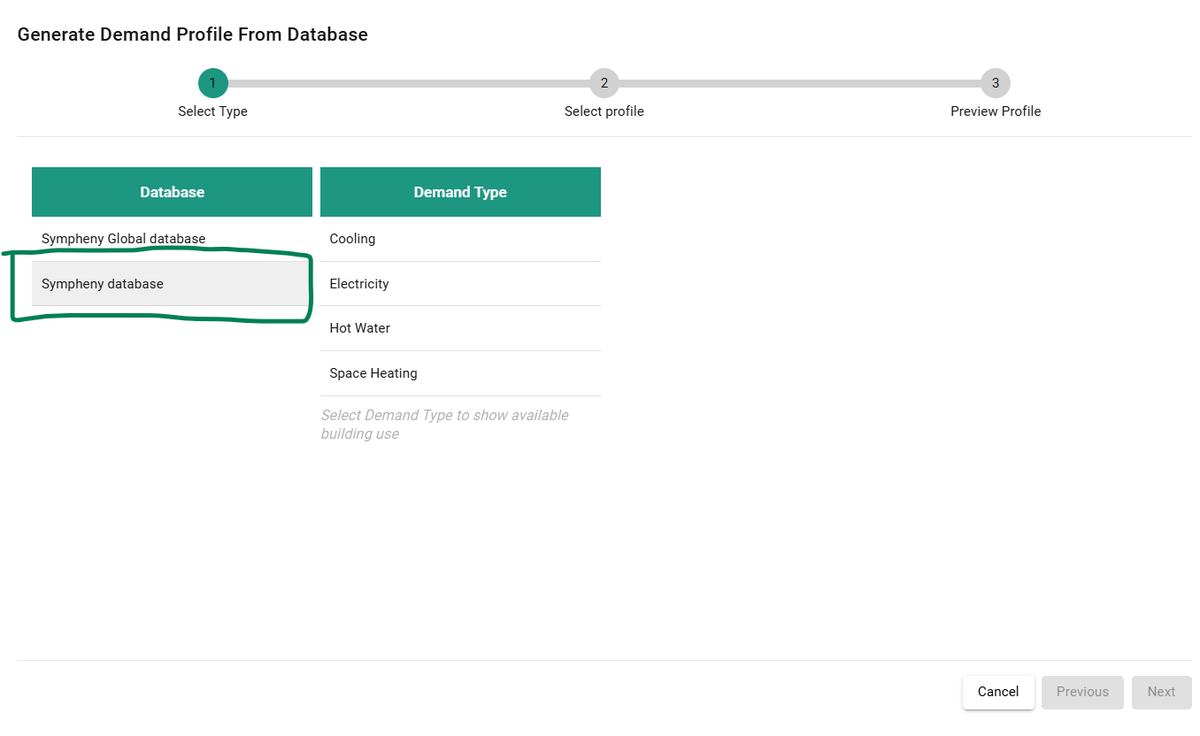
To use your profile, click Generate Profile when adding a new demand in step 4, then click your organisation database (in this example, "Sympheny database"):
Currency
The cost database is maintained in CHF.
Through the scenario editor
When you save a technology to the database while working in another currency (for example, EUR), the data is converted to CHF using the exchange rate in the scenario. When that database entry is used again in the future, it's converted from CHF back to the current EUR value using the exchange rate of the new scenario.
For example, working with EUR and an exchange rate of 1.1 (1 CHF = 1.1 EUR):
- You save a technology from the scenario editor with a value of 1,100 EUR.
- In the database, this technology is saved as 1,100 EUR × (1 / 1.1) CHF/EUR = 1,000 CHF.
- In a later scenario with an exchange rate of 1.2 (1 CHF = 1.2 EUR), this technology, when selected from the database, is entered as 1,000 CHF × 1.2 = 1,200 EUR.
Through the upload from Database Center
When you upload data through the Excel upload, the data is in CHF.
Templates
Download the upload templates here:
Conversion technologies
Conversion technologies template (XLSX)
Last updated: 2024-11-04
Storage technologies
Storage technologies template (XLSX)
Last updated: 2024-11-04
Network technologies
Network technologies template (XLSX)
Last updated: 2024-11-04
Energy demands
My User Database
Energy demands template for My User Database (XLSX)
Last updated: 2024-11-04
Organization Database
Energy demands template for the Organization Database (XLSX)
Last updated: 2024-11-04